Desert Online General Trading LLC
Dubai, United Arab Emirates
Desert Online General Trading LLC
Dubai, United Arab Emirates


Full description not available
U**E
We need more people like Ostrom
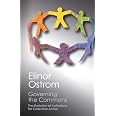
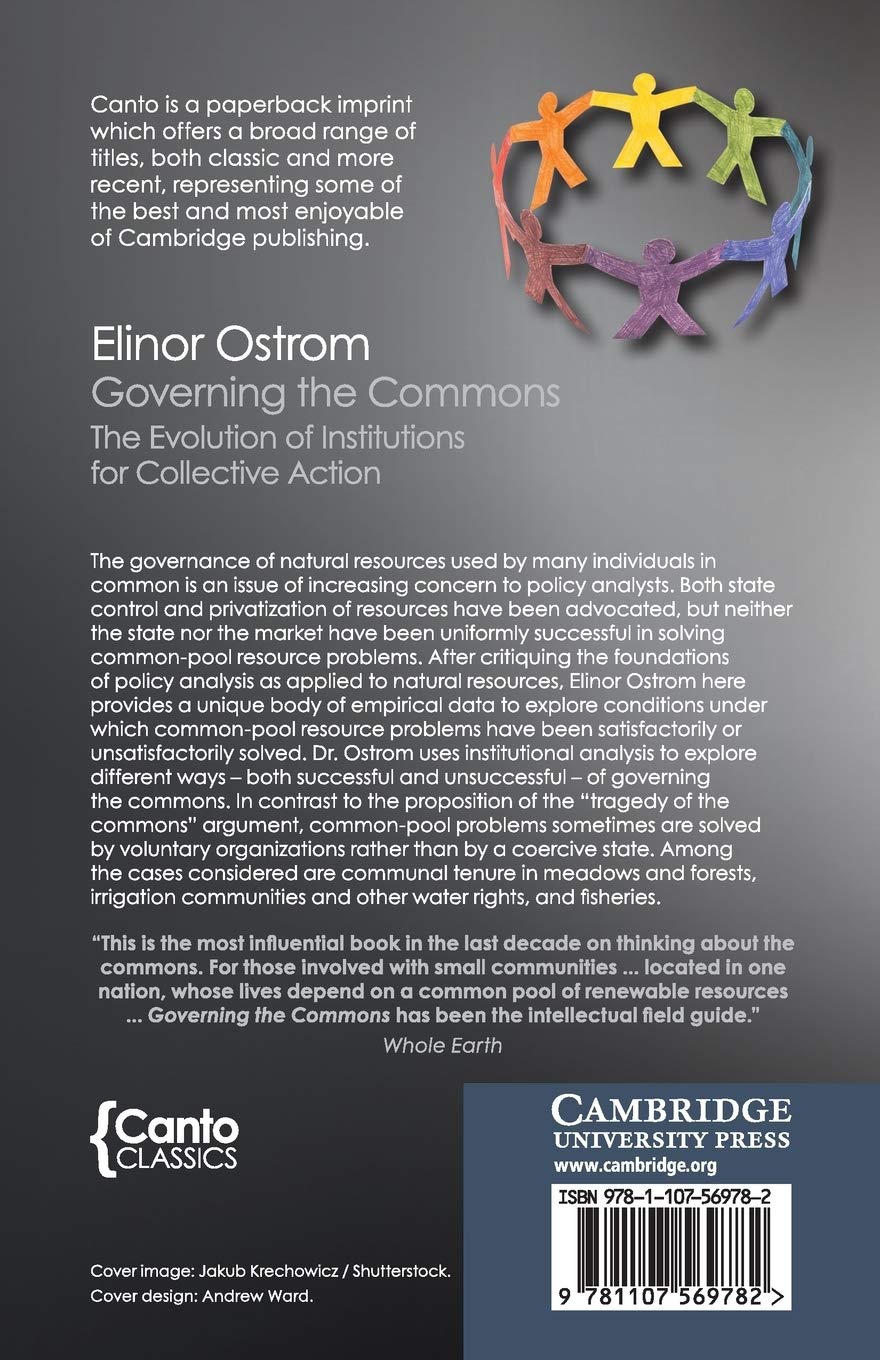
I am surprised that there's little review activity going on for this book, even though the author has won the "fake nobel" prize (i.e. the "price in memory of alfred nobel" for economy). Regardless of what one thinks about the fake nobel, the author is certainly someone whose achievements deserve recognition. This book is a pedagogical summary of the important work that she's done in relation to "Common Pool Resources".It is written in an accurate and scientific style that never falls into the jargon trap. This gives a vivid impression of the author as someone open minded and keeping her thinking clear and focused on the facts.After an introduction on her intentions and method, she presents the so called "tragedy of the commons" (and its close kin, the "prisoner's dilemna") as a situation where theoretical thinking sees central intervention as the only way to break the (self)destructive behaviour predicted and often observed: everyone tries to appropriate as much as they can get away from common resources until those resources collapse and everyone becomes worse off. She then calls attention to several field situations where individuals have been able to organize themselves to avoid falling into this trap without external intervention. The situations described are as diverse as mountain terrain in Switzerland, irrigation land in Spain and the Philippines or even fisheries in Turkey. Ostrom provides a detailed description of the salient features of these institutions before highlighting the common ground and the differences. She points out that these examples have institutions that have been stable for a long time and that we're therefore unsure about the process through which the institutions themselves were created.She then turns to more recent examples of successful institutions managing CPR where information is available regarding the institutional development that led to the current situation. The key examples are water management institutions in California and a project to improve local irrigation communities in Sri Lanka. She finally contrasts successful institutions with failing ones, with a view to identify whether factors that may have been thought of as being factors of success may not actually be irrelevant.The overall message of the book is that it is possible for local communities to take care of themselves and to efficiently manage CPR. It is not easy though and certain type of government intervention actually makes the matter worse. Likewise privatization is also not a one size fits all solution. So she's basically highlighting the need to consider each situation on its own, without ideological glasses. She provides a framework to analyze each specific case, but certainly avoids over-generalization.The world needs more people like Ostrom, (i.e. lucid thinkers genuinely interested to understand what goes on). Too bad the typical social "scientist" seems to be more interested to bend the facts to fit to his theories and ideologies.
D**R
How to Prevent "The Tragedy of the Commons"
Resources jointly held by many, especially those that are susceptible to use by "free riders" who contribute nothing to the creation and maintenance of the resource, present fertile ground for "the tragedy of the commons," where the common pool resource (CPR) is depleted by over-use and under-support.Elinor Ostrom won the prize in economics analogous to the Nobel Prize in other fields. She was awarded this because of her ground-breaking work in studying the management of common pool resources worldwide, resources like water basins of California, fisheries off Nova Scotia, grazing lands and farming lands jointly held in foreign lands.Ostrom describes successful ventures and unsuccessful ones, and she gives some guidance on how to manage the commons and under which conditions that management is likely to succeed when done very locally, or bottom-up.Throughout, the book is highly readable and heavily documented.
R**S
Exceptionally valuable book on cooperative resource management
Governing the Commons is an excellent exploration of how people can work together to manage shared, limited resources. It is a bit of a heavy read, but I found it very worthwhile. One of its basic points is that the Garret Hardin "Tragedy of the Commons" idea is not inevitable. There are many examples of communities setting up stable, long term institutions for managing common resources such as water supplies, fisheries, and forests. Ostrom outlines the interaction between local private initiatives, administrative organizations such as water districts, and legal frameworks provided by government. She also describes how favoritism, bribery, and corruption to thwart such efforts. A very good read for anyone thinking along the lines of "Think Global, Act Local."
O**R
Great product but short in details
Seller was great in delivering the product on time and well packaged. Perhaps an oversight on their part, but a little bit more details on product description would avoid unnecessary confusion and provide more clarity to the buyer. A simple one word description of "good" quite frankly makes it more ambiguous than helpful and omission of important details like notes or underlining looks not so good. As a rule of thumb, under promise and over deliver when possible.
Q**N
Absolutely brilliant!
In this remarkable book, the author presents detailed case studies and a theoretical framework for how communities can manage common resources. She literally provides the counter argument to the tragedy of the commons. Some of the examples she describes are shared resources that have been successfully managed by the people using them for thousands of years! This is a must read for anyone seeking knowledge about how to create durable institutions that can help us preserve valuable natural resources while benefiting from them economically at the same time.
A**R
Unbelievable number of typos in an otherwise outstanding book.
This is a fantastic book that dispels a lifetime of wrong notions about common resource issues. The only puzzling thing about the book is the incredible number of typos! I have never read a book containing so many problems with the editing. It makes following a complex argument that much more difficult when I have to try to interpret what every typo really means. You may want to try the other edition.
M**R
Excellent Analysis; Required Reading
Brilliant analysis! Ostrom's work deserves the fame it has achieved. Anyone involved with public goods from common resource pools in any way should read this.
A**T
Good content but it reads like a car manual…
The ideas presented in this book are great, if you can get past the endless theoretical comparisons and scientific games.. There was no attempt to make this book hold your attention at all.. it is A very painful read.
Trustpilot
1 month ago
2 weeks ago